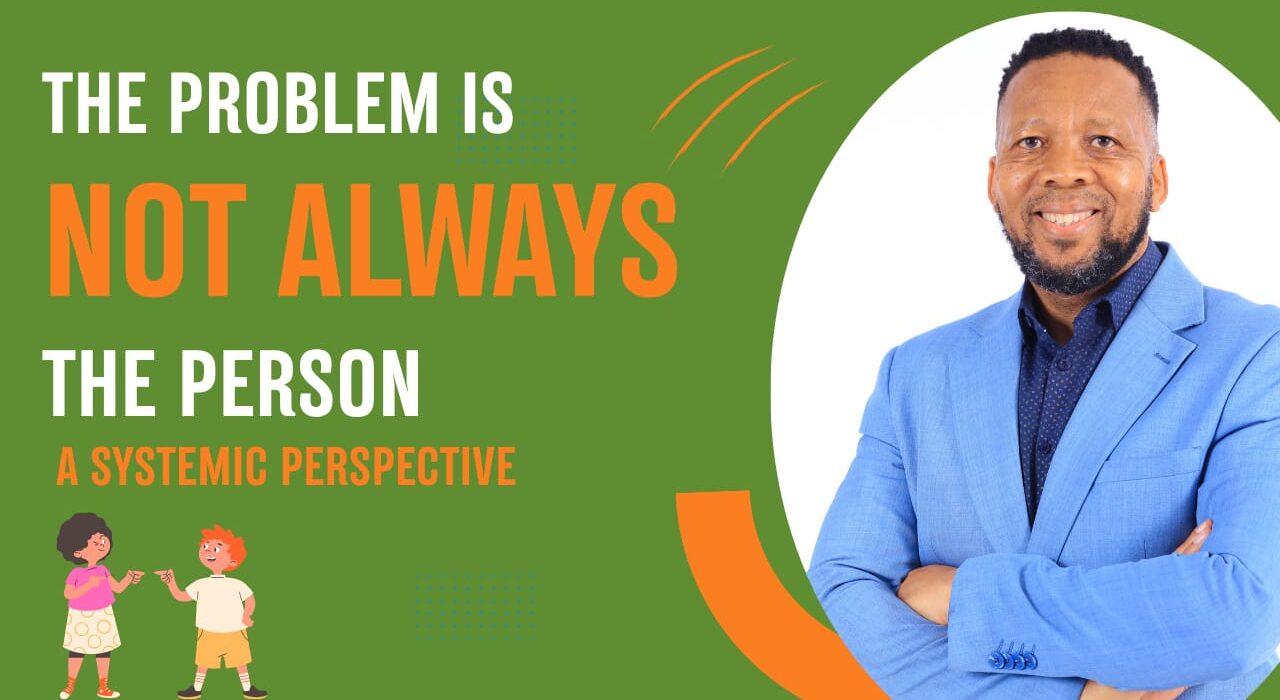
The Problem Is Not Always the Person: A Systemic Perspective
When something goes wrong, we naturally look for the person responsible.
The difficult employee.
The rebellious child.
The uncooperative partner.
The family member who always seems to create conflict.
The student who will not listen.
Finding the person who appears to be causing the problem gives us somewhere to focus our attention. If only that person would change, we think, perhaps everything would be better.
Sometimes an individual does need to take responsibility and change their behaviour.
But through a systemic lens, there is another question worth asking:
What if the problem is not always located entirely within the person?
Behaviour Happens Somewhere
None of us behaves in isolation.
We behave within relationships, families, workplaces, schools, communities and cultures. What happens around us influences how we respond, just as our behaviour influences the people around us.
Consider a child whose behaviour suddenly changes at school.
Perhaps the child becomes disruptive, withdrawn or difficult to manage.
It would be easy to describe the child as having a behavioural problem.
But what happens when we widen the lens?
Perhaps there has been significant change at home.
Perhaps the child is being bullied.
Perhaps there is academic pressure.
Perhaps the child is struggling to find a sense of belonging.
Perhaps something has changed in an important relationship.
The behaviour still matters. The child may still need support and appropriate limits.
But once we understand the context, the behaviour may begin to mean something different.
Instead of seeing only a difficult child, we may begin to see a child responding to a difficult situation.
The Same Is True of Adults
Adults are no different.
A person who appears withdrawn in a relationship may be responding to repeated criticism or conflict.
An employee who was once enthusiastic but has become disengaged may be working within an environment where effort is rarely acknowledged.
A partner who constantly seeks reassurance may be participating in a relationship where the other person responds to emotional closeness by withdrawing.
A family member who has acquired the reputation of being “the difficult one” may sometimes be expressing tensions that exist within the wider family.
This does not mean that behaviour should be excused.
Understanding context and taking responsibility can exist at the same time.
The systemic question is not:
“Who can we blame instead?”
It is:
“What else is happening here?”
When One Person Becomes the Problem
Something interesting can happen in families, workplaces and other groups.
Over time, one person can become identified as the problem.
Once that happens, the system can begin organising itself around that description.
“He has always been difficult.”
“She is too emotional.”
“That child is the problem.”
“He is the reason this team doesn't function.”
The label can become so established that we stop being curious.
We begin interpreting almost everything the person does through what we already believe about them.
And sometimes, focusing entirely on one individual prevents us from seeing the interactions around them.
What happens immediately before the behaviour?
How do other people respond to it?
What happens next?
Does the response reduce the problem, or does it unintentionally help keep the pattern going?
What might we notice if we stopped looking only at one person?
From Blame to Pattern
Imagine a couple in which one partner constantly wants to talk about the relationship while the other repeatedly withdraws.
It may be tempting to decide that one of them is the problem.
Perhaps the first is described as demanding.
Perhaps the second is described as emotionally unavailable.
But through a systemic lens, we might become interested in the pattern between them.
The more one person pursues the conversation, the more the other withdraws.
The more the other withdraws, the more urgently the first pursues.
Eventually, both people may feel that the other is causing the problem.
Yet each person's response is also influencing the next response.
The difficulty begins to live not only within either individual, but also between them.
That shift is important.
If we see only two problematic individuals, we try to fix the people.
If we can see the pattern, we can begin asking how both might respond differently.
Accountability Still Matters
Looking systemically should never mean that nobody is responsible for anything.
There are behaviours that are harmful, abusive or unacceptable. Context should not be used to remove personal responsibility.
A systemic lens simply reminds us that explanation and excuse are not the same thing.
We can hold someone accountable for their behaviour while still being curious about the relationships, experiences and environments within which that behaviour developed and continues.
In fact, understanding the wider pattern can sometimes make meaningful change more possible.
If we only tell someone, “You are the problem,” we may produce shame or defensiveness.
If we can also understand what sustains the behaviour, we have more places from which to intervene.
Widening the Lens
The next time you find yourself thinking:
“If only this person would change…”
perhaps pause before settling on that conclusion.
Ask:
What is happening around this person?
What happens between us when the problem appears?
How do I usually respond?
What does my response invite from the other person?
Is there a pattern here that we have stopped noticing?
Sometimes the individual really does need to change.
Sometimes we need to change.
And sometimes what needs attention is the pattern that has developed between us.
A Reflection
Think about someone you have come to experience as “difficult.”
Without denying their responsibility for their behaviour, try widening the lens for a moment.
What becomes visible when you stop looking only at the person and begin looking at the system around the person?
You may not arrive at a completely different answer.
But you may discover a different question.
And sometimes, seeing the problem differently is where meaningful change begins.
Through a Systemic Lens is an ongoing series of reflections by Lobone Raditladi exploring the relationships, patterns and systems that shape our lives.
See the system. Understand the pattern. Create meaningful change.