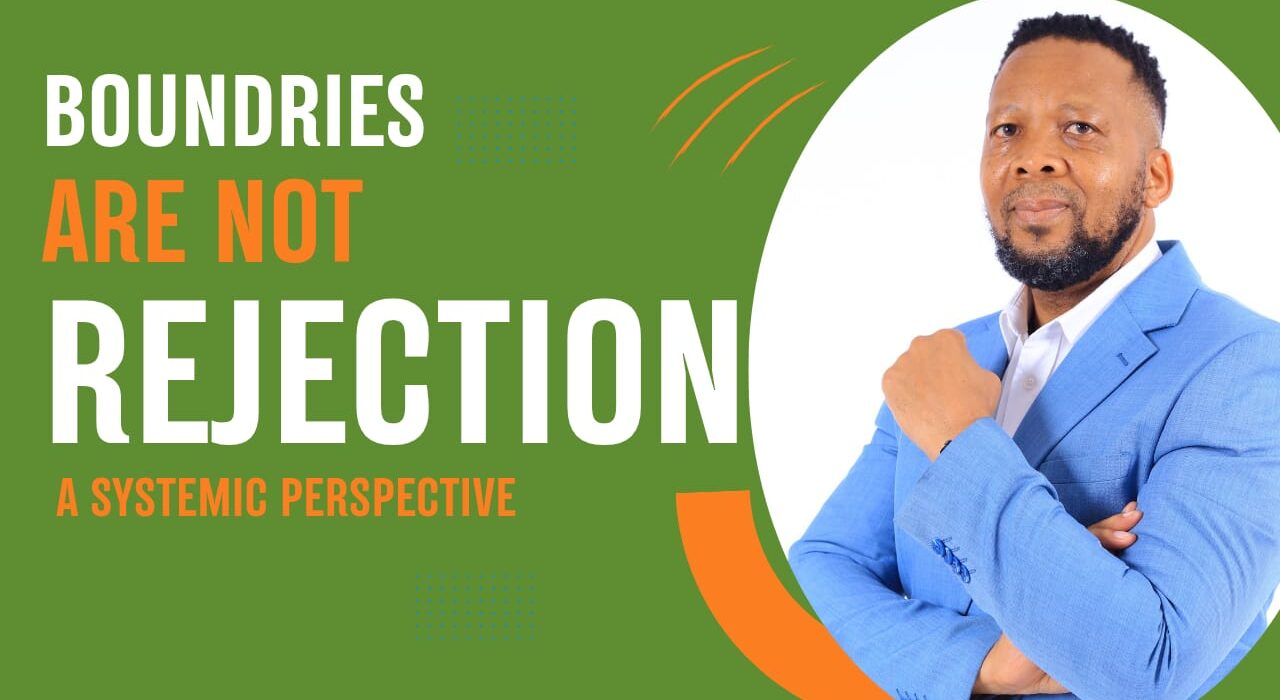
Boundaries Are Not Rejection: A Systemic Perspective
For many people, setting a boundary feels uncomfortable.
We worry that saying no will disappoint someone.
We fear being described as selfish, difficult or uncaring.
Sometimes we agree to things we do not really want to do because the alternative feels worse. We would rather carry the inconvenience ourselves than deal with another person's disappointment.
Underneath this can be a powerful belief:
If I set a boundary, I may damage the relationship.
But boundaries and rejection are not the same thing.
Through a systemic lens, boundaries can be understood not simply as limits between people, but as part of how relationships organise themselves.
Healthy boundaries can allow us to remain connected to others without losing ourselves in the process.
We Learn Boundaries in Relationships
We are not born knowing what healthy boundaries look like.
We learn them within systems.
Our families, communities, friendships, cultures and significant relationships teach us what is expected when we belong.
In some families, saying no is accepted.
In others, saying no may be interpreted as disrespect.
Some people grow up learning that family members should always be available to one another.
Others learn that keeping the peace is more important than expressing disagreement.
We may learn that love means sacrifice.
That a good child does not question an elder.
That a caring partner should always be available.
That helping family is expected regardless of the personal cost.
None of these messages exists in isolation. They develop within particular histories, relationships and cultures.
The difficulty arises when we begin believing that maintaining connection requires us to have no limits at all.
Why Saying No Can Feel Like Rejection
Imagine someone who has always been available to their family.
They lend money when asked.
They rearrange their schedule whenever someone needs something.
They solve problems.
They rarely say no.
Over time, this availability may become part of how the family understands the relationship.
Then one day the person says:
“I'm sorry, I can't do that this time.”
To the person setting the boundary, this may simply mean:
I don't have the capacity.
But another family member may hear:
You don't care about us anymore.
The boundary has been experienced as rejection.
That doesn't necessarily mean the boundary was wrong.
It may mean that the relationship had become organised around the person's constant availability.
When that changes, the system notices.
A Boundary Is Not About Controlling Someone Else
There is an important difference between setting a boundary and trying to control another person.
We sometimes say:
“My boundary is that you cannot speak to me like that.”
But I cannot completely control how another person chooses to speak.
A clearer boundary might be:
“If the conversation becomes disrespectful, I will step away and we can continue when we are both calmer.”
The difference is subtle but important.
The first statement focuses primarily on controlling the other person's behaviour.
The second communicates what I will do in response to behaviour I am unwilling to participate in.
Healthy boundaries are often less about telling other people what they must do and more about becoming clear about our own participation.
What am I willing to accept?
What am I able to give?
What will I do when a limit is crossed?
Boundaries Can Protect Connection
We sometimes imagine that boundaries create distance.
But the absence of boundaries can also damage relationships.
When we repeatedly say yes when we want to say no, resentment can develop.
When we continually give beyond our capacity, exhaustion can develop.
When we avoid difficult conversations to maintain peace, unresolved frustration can accumulate.
Eventually, the relationship we were trying to protect may become strained by the very things we were afraid to communicate.
A thoughtful boundary can therefore be an act of honesty.
I want to remain in this relationship, but I also need to be honest about what I can and cannot offer.
Sometimes clarity protects relationships better than silent resentment.
Expect the Relationship to Respond
One of the most difficult parts of setting boundaries is what happens afterwards.
People may not like them.
Someone who benefited from your constant availability may experience your new limit as unfair.
Someone accustomed to you avoiding conflict may be surprised when you begin speaking up.
Someone who has always relied on you to solve problems may accuse you of no longer caring when you step back.
You may hear:
“You've changed.”
“You're selfish.”
“You never used to be like this.”
This can create guilt, especially when the relationship matters deeply to us.
Through a systemic lens, however, resistance can sometimes be understood differently.
When one person changes their position in a relationship, the rest of the system has to adjust.
The discomfort that follows does not automatically tell us whether the boundary is healthy or unhealthy.
It tells us that something in the familiar pattern has changed.
Not Every Boundary Is Healthy
It is also important not to romanticise boundaries.
The language of boundaries can sometimes be used to avoid accountability, punish people or shut down necessary conversations.
Ignoring someone to force them to behave differently is not automatically a healthy boundary.
Refusing every uncomfortable conversation is not necessarily self-protection.
Cutting people off whenever they disagree with us is not always growth.
Healthy boundaries still require reflection, communication and an awareness that relationships involve other people with legitimate needs and perspectives.
The question is not simply:
Do I have boundaries?
It is also:
What are my boundaries doing to the relationship?
Are they helping create clarity and mutual respect?
Or are they being used to control, punish or avoid?
Boundaries and Guilt
Even a reasonable boundary can produce guilt.
This is particularly true when we have spent years being accommodating.
The feeling of guilt does not necessarily mean we have done something wrong.
Sometimes guilt simply tells us that we are behaving differently from what we have been conditioned to do.
If you have always believed that being a good person means saying yes, then saying no may initially feel wrong.
The task is not necessarily to eliminate the discomfort immediately.
It may be to become curious about it.
What am I afraid this person will think of me?
What have I learned about saying no?
Why does disappointing someone feel so threatening?
What do I believe I must do to remain loved or accepted?
These questions take us beneath the boundary itself and into the system that shaped our relationship with boundaries.
Boundaries Without Rejection
A boundary can be communicated with warmth.
It can acknowledge the relationship while remaining clear.
“I understand that this is important to you, but I can't commit to it.”
“I care about you, but I'm not able to take responsibility for this.”
“I want us to resolve this, but I don't want us to continue the conversation while we're shouting at each other.”
“I can't help financially this time, but that doesn't mean I don't care about what you're going through.”
There is no guarantee that the other person will appreciate the boundary.
But we can communicate it without unnecessarily turning it into rejection.
A Reflection
Think about a relationship in which you find it particularly difficult to say no.
Then ask yourself:
What do I imagine will happen if I set a limit?
Am I afraid of disappointing the person?
Am I afraid they will withdraw?
Do I worry that they will think I am selfish?
Have I learned to associate love with always being available?
And perhaps the deeper question:
What would it look like to remain connected to this person without abandoning my own limits?
Boundaries do not have to mean:
I don't want you in my life.
Sometimes they mean:
I value this relationship enough to be honest about how I can participate in it.
Healthy boundaries are not necessarily about pushing people away.
Sometimes they are what allow us to stay connected without losing ourselves.
Through a Systemic Lens is an ongoing series of reflections by Lobone Raditladi exploring the relationships, patterns and systems that shape our lives.
See the system. Understand the pattern. Create meaningful change.